

Teaching concepts like finding evidence, organizing thoughts, and analyzing is not easy, and these are among the ELA skills students struggle with most. In today’s blog post, let’s dive into some of these more problematic skills and provide some ideas for how you might go about helping your students work through them.
Let’s be honest, there are some skills that middle school students just struggle with. If you asked 10 ELA teachers who’ve been around for a while what their students struggle with most, I’m guessing their lists would be very similar. There are just some ELA topics and skills that are harder for kids to wrap their heads around.
Middle school ELA isn’t hard because students can’t learn the skills; it’s hard because many of the skills we teach are complex, layered, and still developing. Most struggles don’t come from laziness or lack of effort; they come from skills that haven’t fully clicked yet.
The good news? We’ve got several ideas and resources to help you work on these skills with your students.
Below are some of the most common ELA skill gaps we see in middle school classrooms. We’re explaining why students may be getting hung up on these skills and providing ideas for activities and resources you can use to help your students develop them further.

Although there are many ELA skills students struggle with, we have chosen 5 to discuss that seem to come up most often and are fairly consistent across 6th-9th grade.
Let’s spend a little time dissecting each of these issues.
Students often think that any quote counts as evidence. They may grab the first sentence they see, summarize vaguely instead of quoting, or drop evidence without explaining how it supports their point.
This usually happens because:
Here are a few simple activities and resources you can use to help students work on weak/vague claims.
Idea #1: Evidence Races
Turn evidence-finding into an active, competitive process. Give students claims and have them race to find the best supporting evidence, not just any line from the text. To make the evidence race more effective, require an explanation before it counts. We love this activity because it gets students thinking, moving around, and asks them to defend their choices.
Idea #2: Paired Passages
Using two texts forces students to think more carefully about evidence. They must decide which text supports their idea best and why. This naturally deepens their reasoning without extra prep.
There are many ways to use Paired Passages, so you can use them exactly as they are designed, or you can use the texts in other ways. If you want more ways to stretch one text, check out our blog post: “Same Paired Passage…10 Different Activities.”

Many students know what they want to say, but they don’t know how to structure it. They write in the order ideas pop into their heads, resulting in rambling paragraphs or essays that feel scattered.
This often comes from:
Here are a couple of ideas we have for helping to fix this issue as you work with your middle school ELA students.
Idea #1: Outlines Before Drafts
Require a simple outline before any major writing assignment. Even a few bullet points can dramatically improve clarity. You can even have students write their paper out directly from the outline. This will force them to think about the different parts of the essay and their overall goal throughout the process.
Idea #2: Model + Annotate Examples
Show students strong and weak examples side by side. Work through the essay and annotate what works, what doesn’t, and why. Seeing structure in action helps students internalize it.
We have developed a unit for each of the writing standards in middle school ELA. Each standard-based unit comes with a variety of handouts, activities, and resources that you can use to help work on that skill. Click on the standard you want to work on with your students below.
7.W.1 – Writing Argumentative and Persuasive Essays with Thesis Statements
7.W.2 – Informational Writing: How to Write a Thesis with Writing Strategies
7.W.3 – Narrative Writing Mini Unit with Graphic Organizers
7.W.4 – Argumentative & Informative Writing Organization, Tone & Style
7.W.5 – Planning & Revision Strategies, Activities & Assessment
7.W.6 – Publish, Cite Sources, & Collaborate using Google Docs
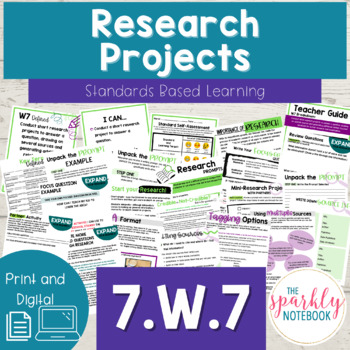
7.W.7 – Research Projects & Citing Sources
7.W.8 – Research Papers: Avoiding Plagiarism, Find & Cite Credible Sources
7.W.9 – Literary Analysis & Informational Writing




Students answer what happened, but not why it matters. They may restate the question, summarize the text, or give one-sentence responses that lack depth.
This happens when:
Here are a few simple fixes to help students create stronger, more complete answers to questions.
Idea #1: Question Unpacking
Before answering a question (or when assigning a question), have students answer the following questions:
Idea #2: Sentence Expansion
Challenge students to build answers in layers. As with starting each essay with an outline, students should create an outline to answer a question.
This structure helps move responses beyond surface-level thinking.
Analysis is abstract. Students often don’t know how it’s different from a summary, so they default to retelling the text rather than focusing on the meaning of the text.
This is especially common when:
Here are some ideas for analyzing with your students.
Idea #1: “So What?” Follow-Ups
After any summary statement, require a “So what?” explanation. This forces students to explain significance, not just content. When a little kid asks their parent “Why” over and over and over again, they are searching for a deeper understanding.
A good analysis essentially answers the question “Why” many times over. But with middle schoolers, we aren’t going to ask why, we’re going to ask “so what?” This phrase is a little more pointed and gets to the goal faster than just asking “Why” again and again.
Idea #2: Discussion Before Writing
Use short discussions, partner talk, or Socratic-style questions to talk through the analysis before students write it. Speaking often clarifies thinking. When students talk through something before writing or presenting a final answer, they have time to flesh out their ideas.
As we mentioned above, one reason students may be jumping straight to summarizing is that they are moving too quickly into the task. Even a 2-3 minute discussion of the reading can result in a deeper analysis.
Middle schoolers are not naturally wired for sustained quiet focus. Longer passages and multi-step writing tasks can feel exhausting and completely out of character for kids who are used to jumping from one thing to the next.
This doesn’t mean they can’t do it; it means they need practice.
Idea #1: Gradual Build-Up
Increase reading length and writing complexity slowly. Think of stamina like a muscle: build it over time. Start the year with short stories, then longer stories, then short novels, and eventually longer novels. This simple build-up will allow students to build some confidence and focus before jumping into longer works.
Idea #2: Chunking Tasks
Break assignments into clear steps with checkpoints. Students are far more successful when they know exactly what to tackle next, and when the tasks feel manageable.
If a student is struggling to move forward, break the tasks down even more!
Most ELA struggles aren’t mysteries. There are signs that students need:
You don’t need to abandon your curriculum or add endless worksheets to help students develop these skills. Small shifts like rethinking how you practice evidence, organization, and analysis can make a huge difference.
Strong ELA instruction isn’t about covering more. It’s about helping skills stick through thoughtful activities, resources, and specifically focused practice.
And when those skills finally stick, everything else starts to fall into place.