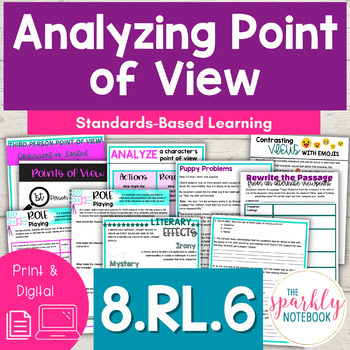
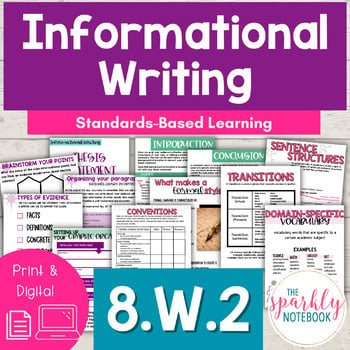
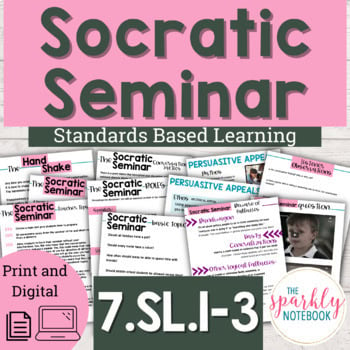
8.SL.1-3 Collaborative Discussions & Socratic Seminars for 8th Grade
$12.00
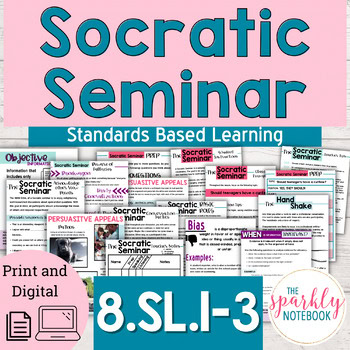
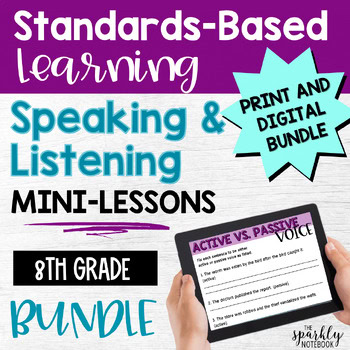
Ready to host Socratic Seminars in 8th grade ELA? This 66 page mini-unit about collaborative discussions includes a full Socratic Seminar, plus all you need to check for understanding and mastery of SL.8.1-3.
Ready to host Socratic Seminars in 8th grade ELA? This 66 page mini-unit about collaborative discussions includes a full Socratic Seminar, plus all you need to check for understanding and mastery of SL.8.1-3.
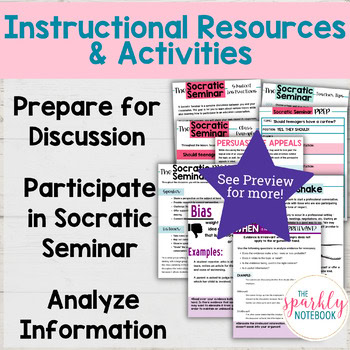
With this standards-based resource, students will have access to several instructional resources and activities centered around class discussions.
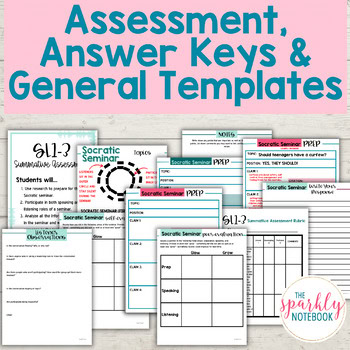
This resource includes everything you need to check for understanding, including a summative assessment with a rubric. A teacher guide breaking down the standard into learning targets and Depth of Knowledge (DOK) stages is also included.
This resource includes both a printable and digital version that is ready for Google Classroom and other distance learning platforms.
You can use this resource:
To give extra practice with CCSS 8.SL.1-3
To give students extra speaking and listening practice
For assessments and test prep
To use Socratic Seminars with your students
How will this resource help me?
Easily assess where students are in their understanding of this standard
Encourage students to self-assess their own growth
Ensure standard mastery by assessing each objective within the standard
Standards addressed:
8SL1: Engage effectively in a range of collaborative discussions (one-on-one, in groups, and teacher-led) with diverse partners on grade 8 topics and texts, building on others’ ideas and expressing their own clearly.
Come to discussions prepared, having read or researched material under study; explicitly draw on that preparation by referring to evidence on the topic, text, or issue to probe and reflect on ideas under discussion.
Follow rules for collegial discussions and decision-making, track progress toward specific goals and deadlines, and define individual roles as needed.
Pose questions that connect the ideas of several speakers and elicit elaboration and respond to others’ questions and comments with relevant evidence, observations, and ideas.
Acknowledge new information expressed by others, and, when warranted, qualify or justify their own views and understanding in light of the evidence presented.
8.SL.2 Analyze the purpose of information presented in diverse media and formats (e.g., visually, quantitatively, orally) and evaluate the motives (e.g., social, commercial, political) behind its presentation.
8.SL.3 Delineate a speaker’s argument and specific claims, evaluating the soundness of the reasoning and relevance and sufficiency of the evidence and identifying when irrelevant evidence is introduced.
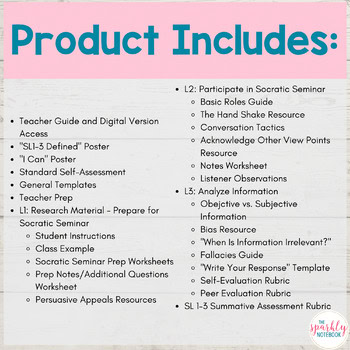
This resource includes:
Teacher Guide with Digital Version Access
SL 1-3 Defined Poster
I Can Poster
Standard Self-Assessment
General Templates
Teacher Prep
L1: Research Material – Prepare for Socratic Seminar
The following standards are addressed with this resource.
CCSSSL.8.1
Engage effectively in a range of collaborative discussions (one-on-one, in groups, and teacher-led) with diverse partners on grade 8 topics, texts, and issues, building on others’ ideas and expressing their own clearly.
CCSSSL.8.1a
Come to discussions prepared, having read or researched material under study; explicitly draw on that preparation by referring to evidence on the topic, text, or issue to probe and reflect on ideas under discussion.
CCSSSL.8.1b
Follow rules for collegial discussions and decision-making, track progress toward specific goals and deadlines, and define individual roles as needed.
CCSSSL.8.1c
Pose questions that connect the ideas of several speakers and respond to others’ questions and comments with relevant evidence, observations, and ideas.
CCSSSL.8.1d
Acknowledge new information expressed by others, and, when warranted, qualify or justify their own views in light of the evidence presented.
CCSSSL.8.2
Analyze the purpose of information presented in diverse media and formats (e.g., visually, quantitatively, orally) and evaluate the motives (e.g., social, commercial, political) behind its presentation.
CCSSSL.8.3
Delineate a speaker’s argument and specific claims, evaluating the soundness of the reasoning and relevance and sufficiency of the evidence and identifying when irrelevant evidence is introduced.
FAQs
Are answer keys included?
Yes. The answer keys are included as the last pages of the resource download.
Do all the activity worksheets need to be completed all at once, or can I split it up?
You could certainly split this up into multiple days/activities. Especially with the long resources. Some activities are easy to split into three “activities”. First, cold read (could be a partner read) w/vocab and multiple choice questions. Second, re-read and summary page. Third, choose one writing activity. You could even do stations. Maybe partner read first, then one station does the vocabulary and summary page. Another station could do the multiple choice, and you could do a teacher-led station with one writing prompt. Then, you can have a fourth station independently write the other prompt. Of course, you know your students better than I do! These are just some ideas!! I try to section out the activities, so you have the freedom to make it work for you!
Is a digital version included?
Yes, all resources within this product line includes a digital version that uses Google Apps.
What is the Lexile level of your reading passages?
Since Lexile is trademarked, I am unable to label them as Lexile levels. However, I have used the free Lexile analyzer and I stay within the recommended grade level range. If there is a specific reading packet that you need details for, please contact me directly and I’ll give you a more specific range.
I just purchased a resource, but I didn’t get it (or can’t find it).
Double-check the SPAM folder in your email inbox. If you find it there, be sure to mark it “NOT SPAM” to keep others from going there. If it is not in your email (inbox or spam folder) after 15 minutes, please reach out with your purchase number.
If you got the email and clicked on the link but can’t find the file, check your downloads folder. The link provided is a FORCE DOWNLOAD link, so it will automatically download to your computer once clicked. Typically this will go to your downloads folder or your desktop, unless otherwise set.
How do I get the downloaded resource from my computer to my Google Drive?
We use cookies on our website to give you the most relevant experience by remembering your preferences and repeat visits. By clicking “Accept All”, you consent to the use of ALL the cookies. However, you may visit "Cookie Settings" to provide a controlled consent.View Terms and Conditions
This website uses cookies to improve your experience while you navigate through the website. Out of these, the cookies that are categorized as necessary are stored on your browser as they are essential for the working of basic functionalities of the website. We also use third-party cookies that help us analyze and understand how you use this website. These cookies will be stored in your browser only with your consent. You also have the option to opt-out of these cookies. But opting out of some of these cookies may affect your browsing experience.
Necessary cookies are absolutely essential for the website to function properly. These cookies ensure basic functionalities and security features of the website, anonymously.
Cookie
Duration
Description
cookielawinfo-checkbox-analytics
11 months
This cookie is set by GDPR Cookie Consent plugin. The cookie is used to store the user consent for the cookies in the category "Analytics".
cookielawinfo-checkbox-functional
11 months
The cookie is set by GDPR cookie consent to record the user consent for the cookies in the category "Functional".
cookielawinfo-checkbox-necessary
11 months
This cookie is set by GDPR Cookie Consent plugin. The cookies is used to store the user consent for the cookies in the category "Necessary".
cookielawinfo-checkbox-others
11 months
This cookie is set by GDPR Cookie Consent plugin. The cookie is used to store the user consent for the cookies in the category "Other.
cookielawinfo-checkbox-performance
11 months
This cookie is set by GDPR Cookie Consent plugin. The cookie is used to store the user consent for the cookies in the category "Performance".
viewed_cookie_policy
11 months
The cookie is set by the GDPR Cookie Consent plugin and is used to store whether or not user has consented to the use of cookies. It does not store any personal data.
Functional cookies help to perform certain functionalities like sharing the content of the website on social media platforms, collect feedbacks, and other third-party features.
Performance cookies are used to understand and analyze the key performance indexes of the website which helps in delivering a better user experience for the visitors.
Analytical cookies are used to understand how visitors interact with the website. These cookies help provide information on metrics the number of visitors, bounce rate, traffic source, etc.
Advertisement cookies are used to provide visitors with relevant ads and marketing campaigns. These cookies track visitors across websites and collect information to provide customized ads.


 Reload document
  Open in new tab