

Set your classroom up for success with these essential Goals for the First Two Weeks of Middle School ELA, from building relationships to starting strong with formative assessments.
The first day of school gets a lot of attention. But if you’re a new teacher, it’s really the first two weeks that can set the tone for your whole year.
No pressure (eye roll)!!
But seriously, there are not a lot of things you have to accomplish in those first two weeks, but there are a few things you may want to consider.
This is the time when you’re establishing routines and, yes, starting to figure out what your students actually know (and don’t know).
So we’re going to strongly recommend that you START SIMPLE.
Here are three goals to focus on during those first two weeks to build a solid foundation for the rest of the year.
Now, it may be surprising that building relationships is not on this list, and that is on purpose. Although building relationships is important, you don’t need to focus on icebreakers, learning names, and things like that.
Students will begin to feel comfortable in your classroom is you are clear, kind, and steady. So our tips are really about those things. Being clear in your expectations, kind to students as you learn about them on the DL, and having a steady presence that doesn’t get too high or too low.
Stick with these 3 things, and you’ll have a great year!
Middle schoolers test limits. It’s not personal—it’s just who they are. That’s why it’s so important to be consistent and clear from the beginning.
Don’t go “easy” on students. If they do something that doesn’t align with your expectations, address it. If you go easy on them at the beginning of the year, they will not appreciate it when you get fed up with their behavior later on and become hypocritical.
Your expectations need to be your expectations from day 1, so commit to what those will be, align them with the school’s expectations for students, and then follow through on exactly what you say you will.
Instead of listing 27 rules on day one, make sure students know your non-negotiables but don’t hound them on it or really spend any time on it on the first day. Students get sooo bored those first couple days of school because everybody is going over what “not” to do.
Instead, get them going on a project or activity that actually means something to your class. That could be a project, sorting activity, or even a digital escape room. Just get them going.
As far as your expectations, address them as they come up.
Each day, take a moment to go over something that is important for being a respectful participant in the class, and as opportunities come up, remind students about your expectations.
And make sure to explain why your routines matter because understanding the reasoning will it help students buy-in.
You don’t need to dive into heavy instruction on day one, but you do want to start collecting information that helps you understand your students as learners.
Use simple, low-pressure activities like:
These help you see skill levels, writing stamina, and even attitude toward school—and you’ll be able to start grouping and differentiating sooner than later.
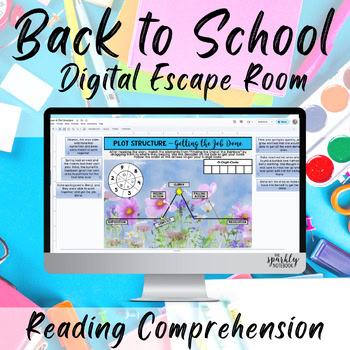
We have a Back to School Digital Escape Room that could really be helpful as you start to assess how much your students know. Check it out here.
Yes, routines and relationships matter. Yes, assessments matter. But you also want to show students early on that your class has purpose and that ELA can be fun.
Here are a few light-touch instructional ideas for the first two weeks:
The key? Don’t try to do it all. Just focus on engaging content + intentional pacing that shows students you’re excited about your content and being able to teach them.
Let’s focus on back-to-school activities for just a little bit longer.
Let’s just say it: Your first two weeks won’t go perfectly. That’s okay.
You’ll forget things. You’ll change plans. You’ll re-teach expectations.
And you’ll probably go home exhausted every single day.
But if you focus on these three main things: setting boundaries, gathering info, and starting light instruction, you’ll be off to a strong start.
You’ve got this. We’re cheering you on every step of the way.