

(Project Series Part 1: Setting up the Classroom Space)
Large projects in middle school ELA can be incredibly powerful, but only if the classroom is set up to support students as they work through the project.
Before students ever pick a topic, read a novel, or open a rubric, the physical and digital environment must be prepared to support students.
A well-designed project space reduces confusion, increases independence, and gives students room to think, create, and collaborate. You also want to eliminate as many questions as possible as students work, so having information available in the right places is also necessary.
In this first post of our project series, we’re focusing entirely on how to set up your classroom space with specific considerations for individual projects, partner projects, and group projects.

There are 3 main types of large projects in middle school ELA: individual projects, partner projects, and large group projects. Let’s start with individual projects.
Individual projects thrive in environments that balance focus, structure, and flexibility. Not all students work the same when they work on their own, so you have to make sure the structures and supports are in place for all styles of individual workers.
Students working independently still benefit from choice. Consider these different seating arrangements.
Having all 3 of these spaces available allows students to choose what they need. You don’t need a full classroom makeover just enough flexibility that students can move if their current spot isn’t working.
The teacher’s role in these types of projects is to be the guide, which means that you’ll be moving around the room and engaging with students as need and at random. The problem occurs when you spend the entire period answering questions that students should already know the answer to.
When students work independently, they should not need to interrupt you constantly.
To prevent students from having to interrupt you, or come to you with easy-to-answer question, consider setting up the following structures:
The goal is independence, not permission-seeking.
For individual projects, students need constant access to directions, so post the information for the projects EVERYWHERE!! Every paper or piece of information should be in a packet given to students with a cover that is a clear and identifiable color (i.e. orange).
The information should also be posted on the wall and available online. Daily goals/checkpoints (if any) should be posted in the same spot everyday somewhere in the classroom, and maybe sent via email to students each morning, so that everybody has multiple touchpoints with the information.
Redundancy is a good thing. If it’s important, it should live in more than one place.
Note: Don’t allow students to ask you questions that are clearly answered somewhere else. If a student comes up to you asking a question about information that is posted in the room, online, or in their packet, come up with a code to steer them to the information, but don’t give them the information.
For example, if they ask what they need to get done today, and you’ve hung the information on the wall somewhere, hold up a “2” with your fingers. That signals to the student that it is on the wall. If they ask you where the rubric is, hold up a “1.” That is the signal that it is in their packet. This will get the student to realize that all the information they need is available; they need to go looking for it.
This method is necessary no matter if students are working in groups, pairs, or individually.
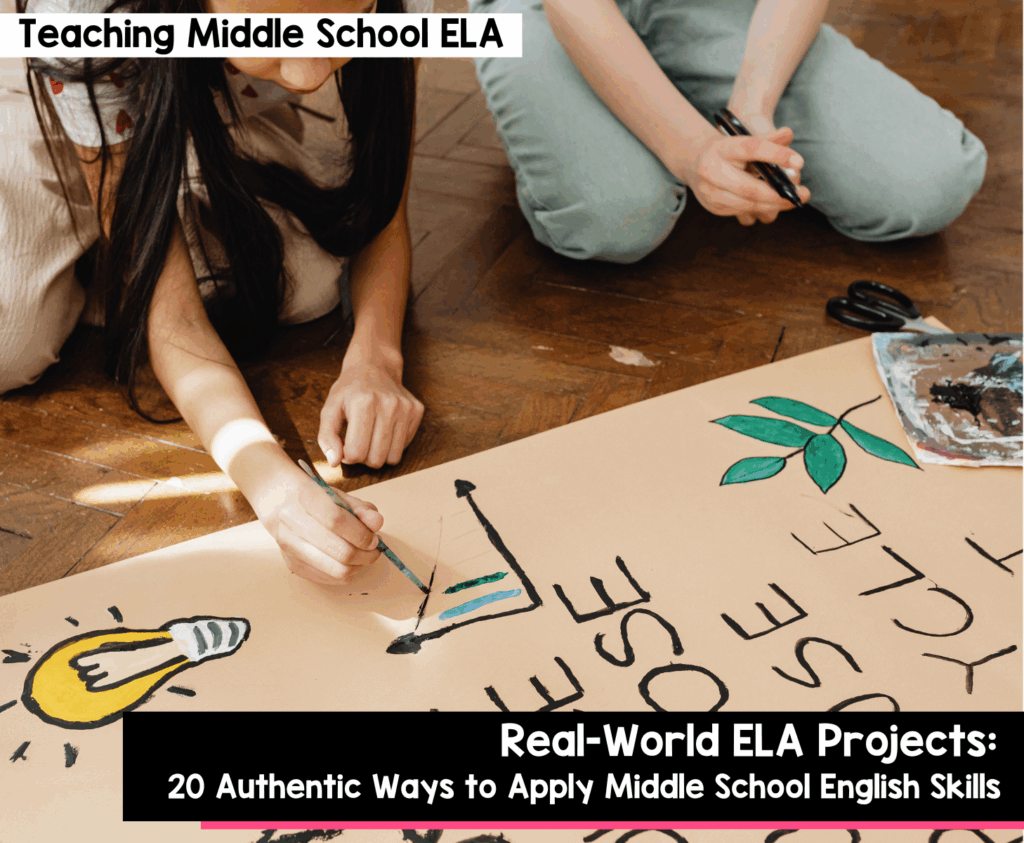
Partner projects require shared ownership and easy collaboration, without turning into chaos.
Partners need to talk, plan, and problem-solve together.
Consider:
Giving partners a defined space helps keep conversations purposeful.
For large projects in middle school ELA, materials should be accessible but structured. All materials for partner projects should be kept together. Designate a shared binder that stays in the room where students note what they are planning, and where they are at in the process. Also, what each person has been completing.
If you have space, give each group a small bin or tub to keep their stuff in. This reduces “Who has the paper?” moments and builds accountability.
If students are working on a computer and sharing files digitally, ask them to share their group folder with you, so you can access their documents as well.
Partner projects benefit from visual reminders. Make sure that you have posters or papers up that clearly state the following:
These reminders reduce conflict and help students self-correct before issues escalate.
Group projects require the most intentional setup, but when done well, they’re incredibly engaging and an excellent way for students to invest in each other and learn to depend on others.
Group work should not feel cramped, and students will need to be able to shift around and sit by different people in their group at different times. Try to incorporate as many of the following as possible.
When setting up for large projects in middle school ELA, don’t try to limit movement with your setup expectations. Movement is not a distraction; it’s often how thinking happens.
Group projects fall apart quickly when materials are scattered. Use a lot of the same setup suggestions we’ve given for individual and partner projects when working with groups as well.
Here is a reminder of some helpful systems:
When students know exactly where their work lives, transitions become smoother.
Group projects involve many moving parts, so we want to keep information super accessible. Post all of the information in a packet, online, and on the wall just as we did before. But also include sheets for daily group goals and progress trackers.
Suggestion: Create ways for students to let you know if their group dynamics need work (for example, a place where students can leave notes about how their group is working together). Having a way of letting students let you know how things are going will allow you to know where to focus your attention the next day.
Large projects in middle school ELA don’t fail because students can’t handle them, they struggle when the environment isn’t designed to support them.
When your classroom:
Students gain confidence, independence, and ownership.
Looking for some ideas for projects? Check out these 20 Real-World ELA Projects for Middle School!
In the next post in this series, we’ll dive into setting up your project timeline.
Stay tuned