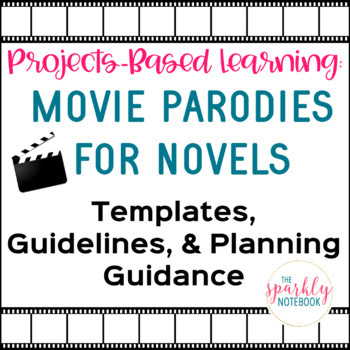
End of Novel Project: Book Parodies – Common Core Aligned
$3.00
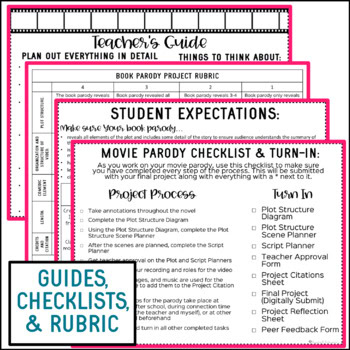
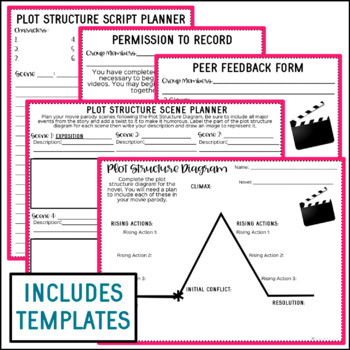
This standards-based book parody project will have students eagerly taking annotations, breaking down the plot structure, and working diligently on rewriting the novel with some humor embedded (and we all know middle schoolers LOVE the opportunity to be funny!) Project-based learning can translate to the real world, and students will love the opportunity to put their tech skills into practice in the classroom.
This standards-based book parody project will have students eagerly taking annotations, breaking down the plot structure, and working diligently on rewriting the novel with some humor embedded (and we all know middle schoolers LOVE the opportunity to be funny!) Project-based learning can translate to the real world, and students will love the opportunity to put their tech skills into practice in the classroom.
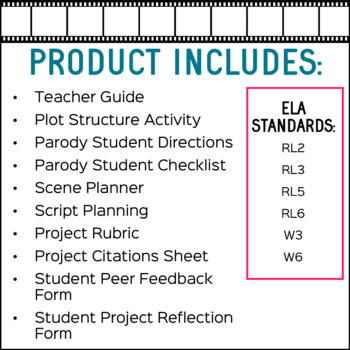
The following standards are addressed with this resource.
CCSSRL.6.2
Determine a theme or central idea of a text and how it is conveyed through particular details; provide a summary of the text distinct from personal opinions or judgments.
CCSSRL.6.3
Describe how a particular story’s or drama’s plot unfolds in a series of episodes as well as how the characters respond or change as the plot moves toward a resolution.
CCSSRL.6.5
Analyze how a particular sentence, chapter, scene, or stanza fits into the overall structure of a text and contributes to the development of the theme, setting, or plot.
CCSSRL.6.6
Explain how an author develops the point of view of the narrator or speaker in a text.
CCSSRL.7.2
Determine a theme or central idea of a text and analyze its development over the course of the text; provide an objective summary of the text.
CCSSRL.7.3
Analyze how particular elements of a story or drama interact (e.g., how setting shapes the characters or plot).
CCSSRL.7.5
Analyze how a drama’s or poem’s form or structure (e.g., soliloquy, sonnet) contributes to its meaning.
CCSSRL.7.6
Analyze how an author develops and contrasts the points of view of different characters or narrators in a text.
CCSSW.6.3
Write narratives to develop real or imagined experiences or events using effective technique, relevant descriptive details, and well-structured event sequences.
CCSSW.6.6
Use technology, including the Internet, to produce and publish writing as well as to interact and collaborate with others; demonstrate sufficient command of keyboarding skills to type a minimum of three pages in a single sitting.
CCSSW.7.3
Write narratives to develop real or imagined experiences or events using effective technique, relevant descriptive details, and well-structured event sequences.
CCSSW.7.6
Use technology, including the Internet, to produce and publish writing and link to and cite sources as well as to interact and collaborate with others, including linking to and citing sources.
We use cookies on our website to give you the most relevant experience by remembering your preferences and repeat visits. By clicking “Accept All”, you consent to the use of ALL the cookies. However, you may visit "Cookie Settings" to provide a controlled consent.View Terms and Conditions
This website uses cookies to improve your experience while you navigate through the website. Out of these, the cookies that are categorized as necessary are stored on your browser as they are essential for the working of basic functionalities of the website. We also use third-party cookies that help us analyze and understand how you use this website. These cookies will be stored in your browser only with your consent. You also have the option to opt-out of these cookies. But opting out of some of these cookies may affect your browsing experience.
Necessary cookies are absolutely essential for the website to function properly. These cookies ensure basic functionalities and security features of the website, anonymously.
Cookie
Duration
Description
cookielawinfo-checkbox-analytics
11 months
This cookie is set by GDPR Cookie Consent plugin. The cookie is used to store the user consent for the cookies in the category "Analytics".
cookielawinfo-checkbox-functional
11 months
The cookie is set by GDPR cookie consent to record the user consent for the cookies in the category "Functional".
cookielawinfo-checkbox-necessary
11 months
This cookie is set by GDPR Cookie Consent plugin. The cookies is used to store the user consent for the cookies in the category "Necessary".
cookielawinfo-checkbox-others
11 months
This cookie is set by GDPR Cookie Consent plugin. The cookie is used to store the user consent for the cookies in the category "Other.
cookielawinfo-checkbox-performance
11 months
This cookie is set by GDPR Cookie Consent plugin. The cookie is used to store the user consent for the cookies in the category "Performance".
viewed_cookie_policy
11 months
The cookie is set by the GDPR Cookie Consent plugin and is used to store whether or not user has consented to the use of cookies. It does not store any personal data.
Functional cookies help to perform certain functionalities like sharing the content of the website on social media platforms, collect feedbacks, and other third-party features.
Performance cookies are used to understand and analyze the key performance indexes of the website which helps in delivering a better user experience for the visitors.
Analytical cookies are used to understand how visitors interact with the website. These cookies help provide information on metrics the number of visitors, bounce rate, traffic source, etc.
Advertisement cookies are used to provide visitors with relevant ads and marketing campaigns. These cookies track visitors across websites and collect information to provide customized ads.


 Loading...

 Reload document
  Open in new tab